
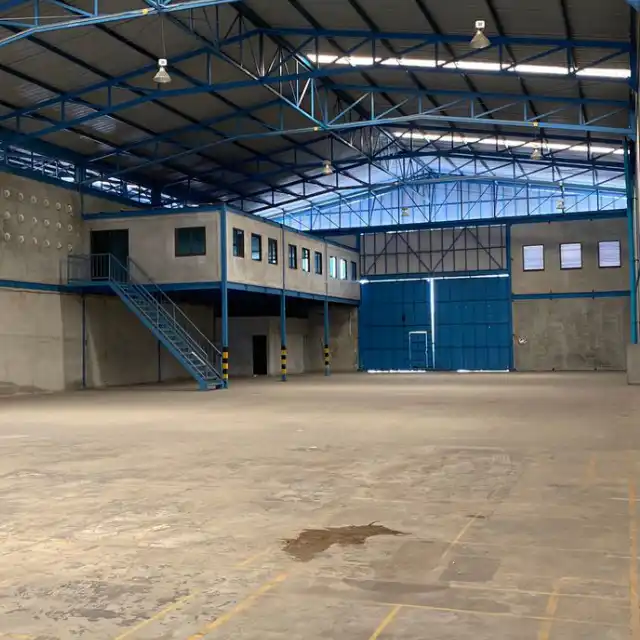
When a company compares alternatives for installing a plant or a distribution center, it is common for the first reference to be the purchase price, the monthly rent or the estimated construction cost.
That data is important, but it is not enough to determine which alternative represents the best financial decision.
An industrial facility generates costs before it begins operations, during its occupancy, and throughout its useful life. It can also influence productivity, maintenance, operational continuity, and the company's growth potential.
Therefore, evaluating an industrial project requires analyzing the initial outlay, recurring expenses, and the economic impact of operating within the facility.
The goal is to compare alternatives using consistent criteria and to understand how much it will cost to use them, not just how much it will cost to obtain them.
What do CAPEX and OPEX mean in an industrial project?
CAPEX and OPEX represent two categories of costs that should be distinguished from the planning stage.
CAPEX, Capital expenditure refers to investments intended to acquire, construct, or improve long-term assets. In an industrial project, this may include the construction of the building, permanent installations, certain equipment, and infrastructure works, depending on the scope and applicable accounting treatment.
OPEX, Operating expenses, or operating costs, comprise the recurring costs necessary to maintain the business. They may include maintenance, utilities, cleaning, security, administration, and other expenses related to the operation of the facility.
The exact accounting classification depends on applicable standards, contracts, and company policies. To evaluate the project, the key is to identify all relevant cash flows and allocate them consistently.
Why it's not advisable to compare only the initial investment
An alternative may require a low initial investment, but generate higher recurring expenses or need frequent adjustments.
Another option may require more resources initially, but offer more efficient distribution, lower maintenance needs, or better operating conditions.
It cannot be concluded that an option is more profitable simply because it has lower CAPEX or a lower income.
The comparison should be made over a common time horizon and considering the real needs of the business.
What should the CAPEX of an industrial facility include?
CAPEX depends on whether the company buys a property, leases an existing warehouse, develops a Built-to-Suit project, or adapts its own facility.
The concepts that can be part of the investment include:
- Acquisition of the land, where applicable.
- Preliminary studies and work.
- Architectural project and engineering.
- Foundation, structure, roof and facades.
- Industrial flooring and exterior works.
- Electrical, hydraulic and sanitary installations.
- Fire protection systems.
- Telecommunications and control infrastructure.
- Specific process adjustments.
- Equipment and machinery, when they are within the scope.
- Supervision, testing and commissioning.
- Financing costs and other items, when relevant to the analysis.
Not all of these items apply to all projects. Furthermore, it is necessary to distinguish between the costs of the property and the equipment directly related to the company's operations.
A clear cost structure facilitates the comparison of proposals and reduces the risk of omitting important concepts.
Contingencies and scope changes
The initial estimate should document its assumptions and acknowledge uncertainties that have not yet been resolved.
For example, if land studies, equipment definitions, or quotes for certain systems are missing, the budget must expressly state this.
A contingency reserve can help manage identified risks, but it is not a substitute for a well-founded estimate. Its amount should be determined based on the maturity of the design, the project conditions, and the company's financial policy.
What should OPEX include?
Operating costs can vary significantly depending on the type of facility, working hours, processes, and the level of service required.
The main concepts include:
Preventive and corrective maintenance. It includes the conservation of systems, equipment and facilities, as well as the interventions necessary to keep them in suitable condition.
Energy and services. Consumption depends on machinery, lighting, air conditioning, material handling equipment, and operating hours.
Water and treatment. Some activities require significant volumes of water or specific treatments before discharge.
Security and operation of the property. They may include surveillance, access control, cleaning, administration, and other contracted services.
Repairs and replacements. Components and equipment have different lifespans. The analysis must consider their wear and tear and replacement needs.
Costs associated with the contract. In leased facilities there may be maintenance fees, insurance, common services or other items defined in the contract.
Costs of periodic upgrades, regulatory compliance, and property management may also be relevant.
It is important to avoid double accounting: the same service should not appear simultaneously as a property expense and as an internal operating cost if it is the same disbursement.
The total cost of occupancy: a more complete view
The total cost of occupancy, known as TCO, allows for the analysis of the resources associated with the use of a facility during a defined period.
Its scope must be established from the outset. Some analyses focus on real estate costs; others incorporate services, maintenance, renovations, and certain operating costs related to the building.
The key is to define a methodology that can be applied equally to all alternatives.
How to build a TCO comparison
First, the evaluation horizon is established. Then, initial outlays, recurring costs, planned future investments, and residual value, where applicable, are identified.
If costs occur at different times, they can be converted to present value using a discount rate appropriate for the company.
A simplified representation is:
TCO in present value = initial investment + present value of future costs − present value of recoveries or residual value.
This expression is an analytical framework, not a universal accounting formula. The specific calculation depends on how the costs, the time horizon, and the cash flows considered are defined.
When comparing lease agreements, the corresponding payments and obligations must also be included according to the financial methodology used by the company.
Illustrative example: an existing building versus a custom-built solution
Let's imagine that a company compares two hypothetical alternatives.
The first is an existing facility that requires certain modifications to adapt to the process. The second is a project designed according to the operational requirements.
The existing building may offer a closer availability date, but may require modifications to the floors, facilities, layout, or security systems.
A customized solution may require more planning before operation, but it allows defining the building's characteristics and the relationship between its areas from the outset.
To compare them correctly, the team should consider:
- Initial investment and disbursement schedule.
- Rent payments or property costs.
- Initial and future adjustments.
- Services and maintenance.
- Operating costs affected by the design.
- Risk of delay and its financial impact.
- Flexibility for process changes.
- Contract duration and exit conditions.
- Expansion capacity.
- Residual value, where applicable.
The comparison must be based on actual project figures. It cannot be generally assumed that a built-to-suit is always cheaper than an existing building, nor that an available facility will necessarily be the lowest-cost option.
How to incorporate time into financial analysis
Time can have a significant economic impact.
If a facility is not ready when the company needs it, expenses may arise such as temporary storage, double operation, equipment relocation, temporary rent, or loss of productive capacity.
On the other hand, bringing forward a delivery date can also involve additional costs if it requires urgent purchases, overtime, or changes in the hiring strategy.
Therefore, the calendar must be connected to the financial model.
Each scenario can include an estimated start date, a disbursement schedule, and the costs associated with a potential delay. When uncertainty exists, it is advisable to perform sensitivity analyses to observe how the outcome changes under different assumptions.
Financial risks that often go unnoticed
Infrastructure not included in the proposal
An estimate may not include certain connections, external works, equipment, or modifications. Before comparing prices, verify that the scopes are equivalent.
Optimistic assumptions about consumption
Energy, water, or maintenance estimates should be based on the characteristics of the operation and not on averages that do not represent its reality.
Subsequent modifications
Changes to processes or equipment can generate additional costs. Early coordination between operations, engineering, and finance helps to reduce them.
Lack of sensitivity analysis
A financial model relies on assumptions. It's worth testing what happens if the investment, operating date, rent, energy costs, or space demand change.
Inadequate evaluation horizon
Comparing a long-term alternative with one evaluated over a different period can lead to incorrect conclusions.
Indicators for evaluating alternatives
Depending on the company's objectives, different indicators can be used:
- Total cost in present value: compares economic flows over a common horizon.
- Equivalent annual cost: It expresses comparable costs as an annual amount, under defined financial assumptions.
- Net present value: It can be used when there are flows of benefits and income attributable to the project.
- Recovery period: It estimates how long it takes to recover an investment under certain assumptions.
- Cost per usable square meter: It allows for the comparison of real estate costs with respect to the effectively usable surface area, provided that a homogeneous definition is used.
- Cost per operating unit: It may be more useful in certain businesses, for example, cost per order prepared or per unit produced.
No single indicator should be interpreted in isolation. Financial analysis must be complemented by technical feasibility, business continuity, and strategic objectives.
Financial checklist before approving the project
- Define the evaluation horizon.
- Separate CAPEX and OPEX with consistent criteria.
- Confirm the scope of each proposal.
- Identify adaptation and start-up costs.
- Estimate maintenance, services and replacements.
- Incorporate relevant contractual payments.
- Link the construction schedule with cash flows.
- Document the assumptions and contingencies.
- Compare cost and delay scenarios.
- Perform sensitivity analysis.
- Review the conclusions with the financial, technical, and operational areas.
Conclusion: The best alternative is the one that works financially throughout its useful life.
The evaluation of an industrial facility must go beyond the purchase price, rent, or construction budget. It is necessary to understand how much it will cost to set it up, maintain it, and operate it over the projected timeframe.
A methodology of CAPEX, OPEX and total occupancy cost allows for comparing alternatives with clear criteria and detecting costs that might otherwise appear after the decision.
MARFA BTS can assist companies in structuring their requirements and in coordinating the technical and real estate decisions that are part of an industrial project.
Are you comparing an existing building with a custom-built project? Contact MARFA BTS to define the scope of your project and establish the factors that should be evaluated before committing to the investment.
Discover our solutions at builttosuit.mx.