
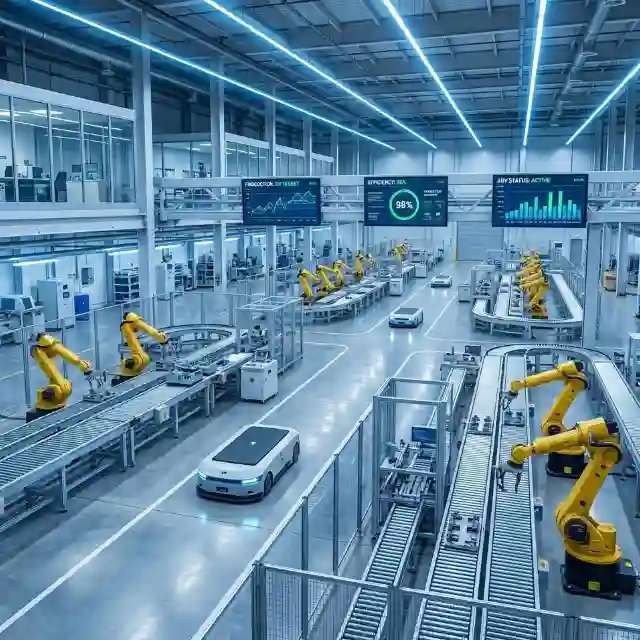
Industrial automation is no longer limited to simply adding robots to a production line. Increasingly, companies are looking to connect equipment, gather information about their processes, improve traceability, and make decisions based on reliable data.
These capabilities are part of what is known as Industry 4.0: an approach that integrates digital technologies, automation, and information systems to improve the way an industrial operation is produced, maintained, and managed.
However, adopting these technologies doesn't necessarily begin with purchasing equipment. It also requires that the physical infrastructure can support them.
A plant designed without considering its future electrical, connectivity, maintenance, or distribution needs may face costly modifications when the company decides to automate a line or integrate new systems.
Therefore, preparing a facility for Industry 4.0 means coordinating the infrastructure, the building, the processes and the technological strategy from the earliest stages of the project.
What is Industry 4.0 in an industrial plant?
Industry 4.0 describes the integration of physical and digital systems into production processes. This can include sensors, controllers, robots, monitoring systems, analytics platforms, predictive maintenance, and tools for tracking materials and products.
Not all plants need to incorporate all of these technologies. The right solution depends on the process, the scale of production, the operational risks, and the business objectives.
One operation might begin with the digital capture of production data and evolve toward broader integration. Another might require advanced automation from its inception for reasons of accuracy, volume, or safety.
The starting point should be to identify what problem you are trying to solve and what capacity the company needs to develop.
Automating is not the same as digitizing
Although they are related, they are different initiatives.
Automation: It uses equipment and control systems to perform tasks with varying degrees of human intervention.
Digitization: It converts information and processes into digital formats that can be recorded, analyzed, and shared.
Connectivity: It allows data exchange between authorized equipment, systems, and platforms.
Analytics: It uses available data to detect patterns, evaluate performance, and support decisions.
A plant can have automated machines without integrating their data into a common system. It can also digitize certain processes before incorporating new robots or automated equipment.
The strategy must establish how these capabilities will complement each other.
Design the facility for the technology that will be used
The architecture and engineering of a plant must consider the process requirements, not just the built volume.
When a company plans for automation, it is important to know the dimensions of the equipment, its loads, its maintenance needs, and the conditions it requires to function correctly.
1. Distribution and production flow
The layout must allow materials, components, finished products, and people to move in an orderly manner.
The incorporation of robots, conveyors, autonomous vehicles, or other systems can modify traffic routes and space requirements.
Therefore, it is advisable to review the sequence of operations, transfer points, supply zones, and maintenance areas.
An efficient layout should reduce interference and allow equipment to operate within its safety parameters.
It should also consider how format changes, cleanings, repairs, and interventions that require stopping a line will be carried out.
2. Electrical capacity and power distribution
Automated equipment may have specific requirements for power, protection, power quality, and backup.
Electrical engineering must start from an updated load relationship and consider foreseeable expansion needs.
In addition to the total capacity, it is advisable to review the distribution of switchboards, the location of conduits, accessibility for maintenance and the adequate separation between power and communications installations, according to the design and applicable standards.
If the plant will incorporate new equipment in different stages, it is advisable to define how they can be connected without making disproportionate modifications.
This doesn't mean installing unlimited capacity from the start. It means designing a solution that allows for growth with reasonable cost and complexity.
3. Industrial networks and connectivity
Control and monitoring systems need a communications infrastructure that is compatible with their performance and security requirements.
Depending on the solution, industrial networks, fiber optics, wireless connections, or other technologies can be used. The selection should be based on the application, the environment, and reliability criteria.
The planning must identify where the equipment will be located, what data it will exchange, what systems will need to communicate, and what security restrictions will apply.
It is also advisable to consider redundancy at critical points, network documentation, and access for maintenance.
Connectivity should not be improvised after the machinery is installed. Routes, technical spaces, and power requirements must be integrated into the engineering design.
4. Technical spaces and environmental conditions
Control cabinets, industrial servers, communications equipment, and auxiliary systems may require spaces with specific conditions.
Temperature, humidity, dust, vibrations, and other environmental factors can affect the performance of certain components.
The facility must provide safe access, ventilation or air conditioning where appropriate, environmental protection and sufficient space to work on the equipment.
It is also important to prevent future expansions from blocking technical access or hindering the replacement of components.
Integrate systems without losing control of information
A digital plant can gather information on machines, production systems, inventories, maintenance, and quality.
To take advantage of it, the company needs to define what data will be collected, who will be able to access it, and how it will be used.
Systems should be designed with an architecture that allows the necessary exchange of information without creating unnecessary or risky connections.
Systems that can be part of the digital architecture
PLCs and control systems. They perform machine and process control functions.
SCADA and supervision. They allow you to visualize variables and operational states in certain applications.
MONTH. It helps to manage and record activities related to the execution of production.
ERP. It integrates business processes such as purchasing, inventory, finance, and planning, according to the company's configuration.
Maintenance systems. They can organize work orders, assets, failure history, and preventative programs.
The need for each system depends on the size and complexity of the operation. Adopting every platform is not essential to begin a digital transformation.
The important thing is to define clear responsibilities, interfaces, and objectives.
Industrial cybersecurity from the design stage
Connecting industrial equipment can improve process visibility, but it also introduces risks that must be managed.
Industrial digital security needs to consider the availability, integrity, and protection of the systems involved in the physical operation.
Measures that can be evaluated include network segmentation, access control, credential management, backups, controlled equipment upgrades, and event monitoring.
Remote interventions by providers must be subject to defined procedures and appropriate authorizations.
Furthermore, older systems may have upgrade or compatibility limitations. The architecture must acknowledge these limitations and implement compensatory measures where necessary.
Cybersecurity is not solely the responsibility of the technology department. It must be coordinated with engineering, operations, maintenance, and industrial safety managers.
Design for maintenance and operational continuity
An automated plant depends on its equipment and systems being available when the operation needs them.
Maintenance should be considered from the design stage through adequate access, intervention spaces, component removal routes and safe working conditions.
It is also advisable to identify equipment whose failure could halt an important part of the process.
Depending on the risk, the company may evaluate redundancy, spare parts inventory, service contracts, or alternative operating procedures.
Predictive maintenance can be useful when reliable data and patterns exist that allow for anticipating certain problems. It does not replace all inspections nor does it guarantee that failures will disappear.
The strategy must combine technology, procedures, training, and operational discipline.
Flexibility to incorporate new technologies
Technology changes rapidly, but that doesn't mean a plant should be built as if all future solutions were already defined.
Flexibility is achieved through concrete decisions: reserving technical spaces when necessary, documenting the installations, facilitating access to pipes and avoiding configurations that make modifications excessively costly.
It is also important to establish standardization criteria for equipment, interfaces, and data, to the extent that it is compatible with the process.
Before expanding a line or incorporating a new system, the team must be able to determine what infrastructure exists, what its limits are, and what modifications would be necessary.
How to assess whether automation makes economic sense
The decision to automate should consider more than just the purchase price of the machinery.
It is necessary to evaluate the expected benefits and the costs of integration, installation, training, maintenance, software, spare parts and possible interruptions during implementation.
Among the indicators that can be analyzed are:
- Production per hour or per shift.
- Defect and rework rate.
- Cycle time.
- Equipment availability.
- Energy consumption per unit produced.
- Times of change and preparation.
- Incidents and exposure to risky tasks.
- Maintenance cost per unit of production.
The selection of indicators should address the problem the company seeks to solve. Automation can be beneficial for increasing consistency or reducing risk exposure, although its return on investment does not depend solely on producing more units.
The results should be estimated using verifiable assumptions and reviewed after implementation.
Common mistakes when preparing a plant for Industry 4.0
Purchase technology before defining the problem
A sophisticated solution may offer little if there is no clear operational need.
Ignoring the physical infrastructure
Power, space, communications and maintenance requirements must be part of the engineering.
Create isolated systems
If the platforms do not exchange information properly, the company may end up duplicating records and processes.
Leaving cybersecurity until last
Security must be integrated into the architecture and access and maintenance procedures.
Failure to train staff
Technology needs people capable of operating it, maintaining it, and using the information it generates.
Designing without an evolution strategy
A solution may work today, but become difficult to scale if its interfaces, constraints, and requirements are not documented.
Checklist for a plant ready for automation
- Define automation and digitization goals.
- Document the processes and material flows.
- Identify current and future equipment.
- Validate electrical loads and backup needs.
- Design connectivity and industrial networks.
- Provide space for technical equipment.
- Define interfaces between systems.
- Establish industrial cybersecurity measures.
- Design access routes for maintenance.
- Evaluate the availability of spare parts and support.
- Train the staff.
- Define indicators to measure results.
Conclusion: The smart plant starts with good engineering
Preparing a plant for Industry 4.0 is not about incorporating as much technology as possible. It's about developing a facility that can support the processes, connect the necessary equipment, and evolve in a controlled manner.
Coordination between architecture, engineering, automation, technology, and operations helps reduce subsequent modifications and creates a more flexible foundation for growth.
At MARFA BTS, technological requirements must be part of the installation planning from the earliest stages, especially when the project needs to integrate production processes, specialized systems and expansion possibilities.
Is your company planning to build a plant or modernize its production capacity? Contact MARFA BTS to define the physical and technical requirements that the installation must consider.
Discover our solutions at builttosuit.mx.