
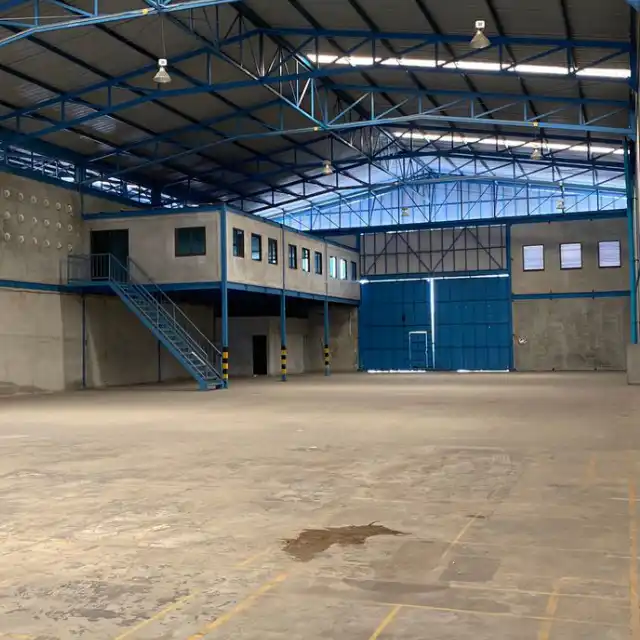
When a company needs to set up shop in Mexico, one of the first real estate decisions often seems very simple:
Do we rent an existing industrial building or develop a Built-to-Suit project?
The answer, however, depends much more on the transaction than on the property.
An available building can represent speed and flexibility. A built-to-suit project can offer customization and better alignment with long-term needs.
The important point is to understand that There is no universally best solution.
The correct solution depends on the type of operation, investment horizon, location, required infrastructure, expected growth, and total occupancy cost.
What is an existing industrial building?
It is a property that has already been built and can be occupied by a company, usually through a lease or purchase agreement.
Its main advantage is obvious:
The building already exists.
This can reduce the time needed to start operations, especially when the vessel has the necessary features.
However, an existing ship was designed for a previous project.
Therefore, before deciding, it is important to check how well it matches the current operation.
What is a Built-to-Suit project?
A Built-to-Suit, or BTS, project is developed specifically according to a company's requirements.
Instead of adapting the operation to the property, the process seeks to do the opposite:
design the infrastructure around the operation.
This may include:
- location;
- surface;
- layout;
- height;
- courtyards;
- platforms;
- offices;
- energy;
- special facilities;
- future expansion.
MARFA BTS proposes precisely a comprehensive model that encompasses location, management, construction and integration of the project.
When might an existing building be suitable?
An existing industrial building can be an excellent alternative when:
- The property meets the specifications;
- The location is strategic;
- the space is sufficient;
- the company needs to start operations quickly;
- The adjustments are minor;
- The occupation horizon does not justify specialized development.
For example, a distribution company with standard requirements can find a perfectly functional warehouse.
In that case, developing from scratch could add unnecessary time and complexity.
When might a Built-to-Suit be appropriate?
BTS starts to become especially interesting when the needs are specific.
For example:
- specialized manufacturing processes;
- automation;
- high energy requirements;
- large courtyards;
- specific storage needs;
- planned expansion;
- specific location;
- special facilities;
- long-term operation.
It can also make sense when the cost of modifying an existing vessel approaches the cost of developing a solution from scratch.
Availability does not mean suitability
The industrial market offers more and more options in certain corridors, but finding available space does not necessarily mean finding the right property.
A ship can be the right size and still not have:
- sufficient energy;
- sufficient yards;
- adequate access;
- required height;
- compatible distribution;
- possibility of expansion;
- optimal location.
Therefore, the decision must begin with a different question:
What does our operation need?
The correct matrix for comparing alternatives
Time
Existing building: It generally has an advantage.
BTS: It requires planning, design, permits, and construction.
Personalization
Existing building: limited by the available structure.
BTS: It can be designed around the processes.
Location
Existing building: It depends on the available supply.
BTS: It allows you to select the location according to the strategy.
Expansion
Existing building: It depends on the terrain and configuration.
BTS: It can be considered from the initial design.
Infrastructure
Existing building: The installed capacity must be verified.
BTS: It is designed according to the needs of the project.
Horizon
Existing building: It may be suitable for short or medium-term operations.
BTS: It usually makes more sense when there is a long-term vision.
The cost that many companies forget
Comparing only monthly rent can lead to a mistaken conclusion.
A cheap ship may require:
- modifications;
- additional facilities;
- structural reinforcement;
- extensions;
- layout changes;
- new electrical infrastructure;
- safety adjustments;
- work in yards and platforms.
All these elements are part of the actual cost of occupancy.
Therefore, it is worth analyzing the TCO, or Total Cost of Occupancy.
The question is:
How much will it actually cost me to get my operation up and running in this property?
Opportunity cost also matters
Imagine a company that needs six months to adapt a warehouse.
During those six months, you may be:
- paying rent;
- moving inventory;
- operating partially;
- delaying a new line;
- awaiting equipment installation.
That time also comes at a cost.
In industrial projects, Time can be turned into money.
BTS does not necessarily mean "to build more expensively"«
BTS's goal should not be to build the most sophisticated building.
It must be built the appropriate building.
A good project can eliminate spaces that do not add value, improve flows, reduce internal travel, and design areas exactly according to the process.
The value lies in the alignment.
What should a company evaluate before making a decision?
Before comparing properties, we recommend defining at least these variables:
- Required surface area.
- Clearance height.
- Number of platforms.
- Maneuvering yard.
- Energy demand.
- Water consumption.
- Production processes.
- Automation.
- Number of employees.
- Need for expansion.
- Customer and supplier locations.
- Occupation horizon.
With this information, an existing ship can be compared against a BTS in a much more objective way.
The ultimate question is not "rent or build?"«
The correct question is:
Which solution offers the best balance between time, cost, operation, risk, and growth?
In some cases it will be an existing building.
In others, it will be a Built-to-Suit project.
The smart decision involves knowing both alternatives before committing to the investment.
A ship should serve the business, not the other way around.
Industrial infrastructure is a tool for operating.
When the property is properly adapted to the operation, the company can make better use of the space, organize its processes and plan for growth.
That is one of the main objectives of a Built-to-Suit project.
Are you comparing alternatives?
MARFA BTS can accompany the process from site identification to project integration and delivery, taking into account the client's operational, legal, and financial needs.
Tell us what your operation needs and let's evaluate together which alternative makes the most sense.