
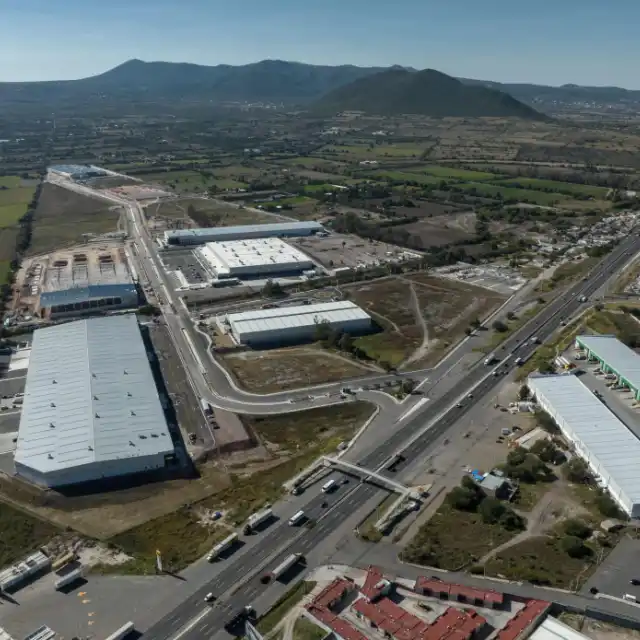
Choosing a region for a new plant or distribution center is a decision that can influence a company's operations for years to come.
Mexico has several industrial corridors that connect consumer markets, suppliers, logistics infrastructure, and manufacturing communities. However, not all regions respond in the same way to a company's needs.
An operation geared towards serving the metropolitan market may have different priorities than a plant that supplies manufacturing chains or exports specialized products.
Therefore, comparing the State of Mexico, Puebla, and the Bajío region requires going beyond a list of general advantages. It is necessary to understand what function the facility will fulfill, how it will relate to the supply chain, and what conditions it needs to operate.
This analysis provides a comparative framework to guide the initial research. The final decision must be validated at the municipal, industrial park, and site levels.
Why compare corridors and not just cities?
Industrial supply chains do not operate in isolation. A plant may depend on suppliers located in different states, transport goods to distribution centers, and serve customers with specific delivery schedules.
Therefore, an industrial region must be analyzed as part of an operational network.
The concept of an industrial corridor allows for the consideration of a group of municipalities, parks, logistics connections, and related labor markets. The advantage of this approach is that it avoids dismissing alternatives simply because they are located outside a well-known city.
However, the boundaries of a corridor do not guarantee uniform conditions. Infrastructure, costs, services, and staff availability can vary from one park to another.
State of Mexico: operations linked to the metropolitan market
The State of Mexico can be a relevant alternative for companies that need to serve the central market of the country and coordinate distribution operations with a broad network of consumers and businesses.
Its suitability depends on the activity, the specific area, and the flow of goods that the facility will have to handle.
What to evaluate in this region
Access to markets. For an operation that supplies the metropolitan area, it is important to measure the actual delivery times and route coverage.
Regional distribution. A distribution center may need connectivity with different highways and the ability to make frequent deliveries to multiple destinations.
Talent availability. The company must identify what profiles it needs, where they are located, and what the usual travel times would be.
Property conditions. The terrain characteristics, access for heavy transport and the conditions of services must be verified for each alternative.
Operating cost. The assessment should consider not only the real estate investment, but also the costs of distribution, personnel, services and outfitting.
Which companies could evaluate it?
It may be relevant for logistics operators, consumer companies, industrial suppliers, and businesses that need a close relationship with the metropolitan market.
However, a specific location may prove inconvenient if access costs, operational restrictions, or plant needs do not match site conditions.
The decision should be based on specific routes and requirements, not on the idea that every location within the State of Mexico offers the same advantages.
Puebla: an alternative for certain manufacturing operations
Puebla is part of a region with manufacturing activity and links to various supply chains. This could be relevant for companies evaluating a production facility, a support operation, or a project that needs to serve markets in central and southeastern Mexico, depending on their trade routes.
Its suitability should be analyzed based on the type of industry, technical requirements, and the network of suppliers and customers.
What to evaluate in Puebla
Relationship with the supply chain. It is important to identify current and potential suppliers, as well as supply times and costs.
Availability of technical profiles. The evaluation should consider the skills required by the process and the ability to attract staff.
Park infrastructure. The conditions of energy, water, telecommunications, drainage and complementary services must be checked.
Access and transport. Connectivity should be evaluated using the actual routes of raw materials and finished products.
Growth capacity. It is worth analyzing whether the site allows for expanding operations or incorporating new production stages.
Which companies could evaluate it?
Puebla may be an option for certain manufacturing operations, industrial suppliers, and companies seeking to develop a facility tailored to a production process.
Relevance depends on the specific activity. The requirements of an advanced manufacturing plant, an assembly facility, and a distribution center can be very different.
Before choosing a site, it is necessary to check the infrastructure conditions and the total cost of enabling it.
Bajío: a region to evaluate manufacturing chains and industrial operations
The Bajío region is often used to describe a region encompassing various industrial markets in west-central Mexico. Its conditions vary depending on the state, municipality, and specific industrial corridor being analyzed.
For some companies, it may offer opportunities related to manufacturing networks, industrial supply chains, and regional distribution. However, these possibilities must be weighed against the specific investment needs.
What to evaluate in the Bajío region
Supplier ecosystem. It is advisable to identify which relevant suppliers are present and which ones can meet the company's requirements for quality, volume, and frequency.
Customer relations. The region may be relevant if the routes to industrial and commercial customers are competitive for the business.
Specialized personnel. It is necessary to validate the availability of the required profiles and the conditions to attract and retain them.
Industrial services. Electrical capacity, water and other required facilities must be confirmed at the site level.
Installation and operating costs. The analysis should incorporate adaptations, transportation, services and possible investments to enable the site.
Which companies could evaluate it?
It may be relevant for certain manufacturing operations, industrial chain suppliers, and companies seeking to combine production with regional distribution.
The decision should not be based solely on an area's industrial reputation. It is necessary to verify whether the chosen location meets the company's requirements and whether services will be available under the expected conditions.
How to compare the three alternatives objectively
A useful comparison begins by establishing the same criteria for each region and applying a consistent methodology.
The following table provides an initial framework. It does not represent a performance ranking nor does it claim that one region is superior to another.
| Criterion | State of Mexico | Puebla | Shallows |
|---|---|---|---|
| Main market | Evaluate access to the metropolitan market | Evaluate downtown markets and other served routes | Evaluate manufacturing markets and regional distribution |
| Suppliers | Identify suppliers located near the operation | Verify relevant suppliers and supply chains | Map suppliers by industry and process |
| Talent | Validate profiles, transfers, and job skills | Validate technical profiles and availability | Validate industry profiles and training needs |
| Infrastructure | Confirm services and access to the property | Confirm park capacity and conditions | Confirm park capacity and conditions |
| Costs | Calculate total project and operation cost | Calculate total project and operation cost | Calculate total project and operation cost |
| Expansion | Check availability and restrictions | Check availability and restrictions | Check availability and restrictions |
The table should be completed with information on the specific alternatives that the company is considering.
Step 1. Define the purpose of the installation
Before comparing regions, determine whether the facility will be a production plant, a distribution center, a warehouse, an assembly operation, or a combination thereof.
It is also necessary to define which markets it will serve, what volume it will handle, and what service requirements it must meet.
Step 2. Map the supply chain flows
Identify the origins of raw materials, the main suppliers, the destinations of products, and the movements between company facilities.
Transit times should be estimated using realistic routes and conditions. Straight-line distances do not necessarily reflect logistical costs.
Step 3. Establish the minimum requirements
Before assigning scores, determine which conditions are mandatory.
For example, an operation may require a certain electrical capacity, a specific volume of water, access for vehicles of certain dimensions, or regulatory compatibility with a specific activity.
If an alternative does not meet an essential requirement and there is no viable solution, it should be identified as a critical risk, not offset by a good rating in another criterion.
Step 4. Compare the total cost
The economic evaluation should incorporate investment, rent or ownership, adaptations, transportation, services, maintenance and other relevant costs.
The evaluation period should be consistent across alternatives and consider, where appropriate, the financial cost of disbursements and the impact of the start date of operations.
Step 5. Validate at the property level
Regional comparison helps define where to investigate. It does not replace a review of the industrial park and the land.
At this stage, documents, infrastructure, physical conditions, restrictions, permits and the scope of the necessary works must be verified.
The mistake of choosing a region based on a single advantage
A region may appear attractive due to its real estate costs, but generate higher transportation expenses or require additional infrastructure investments.
Another option may offer access to suppliers, but not have a viable solution for the technical requirements of the installation.
It is also possible that a corridor is suitable for a manufacturing plant, but not for a distribution center that needs to make frequent deliveries in a specific market.
The decision must assess the entire operation. No single indicator can replace a comprehensive analysis.
When is it appropriate to consider a Built-to-Suit project?
If a company identifies a suitable region but cannot find a ship that meets its requirements, it can evaluate a Built-to-Suit project.
The model allows defining the characteristics of the installation based on the process: distribution, surfaces, floors, platforms, facilities, services and other elements that are part of the scope.
Before proceeding, the feasibility of the land must be verified and a development program established that takes into account the technical and operational needs.
A custom-designed project doesn't eliminate the need to compare locations. It allows you to connect site selection with the design and development of the property within a coordinated strategy.
Checklist for selecting an industrial corridor
- Define the purpose of the installation.
- Identify priority customers and suppliers.
- Map routes and transport times.
- Establish necessary talent profiles.
- Determine minimum infrastructure requirements.
- Compare total costs over the same time horizon.
- Check availability of real estate alternatives.
- Validate the capacity of the parks and properties.
- Identify applicable restrictions and authorizations.
- Evaluate expansion potential.
- Document risks and assumptions for each alternative.
Conclusion: the appropriate region is the one that corresponds to the operation
The State of Mexico, Puebla, and the Bajío region offer distinct contexts that may be relevant to different industrial strategies. There is no single answer that will work for all companies.
The selection should be based on operational requirements, supply chains, costs, and necessary infrastructure. Then, each alternative should be tested at the park and site level to confirm its viability.
MARFA BTS can assist companies in defining requirements, evaluating alternatives, and structuring industrial projects tailored to their needs.
Is your company comparing regions for a new plant or distribution center? Contact MARFA BTS to define evaluation criteria and explore industrial development alternatives.
Discover our solutions at builttosuit.mx.